


Frequently Asked Questions
(Last updated: 7/2/2026)
Print version (PDF)
The below FAQs are for informational purposes only and are intended solely to assist potential applicants in better understanding the AI Upskill Accelerator Pilot Program and the application requirements set forth in Addendum II (AI Addendum) to the FY 2023/2024/2025 Public Works and Economic Adjustment Assistance (PWEAA) Notice of Funding Opportunity (NOFO) for this program. The FAQs do not and are not intended to supersede, modify, or otherwise alter applicable statutory or regulatory requirements, or the specific application requirements set forth in the AI Addendum. In all cases, statutory and regulatory mandates, and the requirements set forth in the AI Addendum shall prevail over any potential inconsistencies contained in the below FAQs.
1. Where can I find the Notice of Funding Opportunity for the AI Upskill Accelerator Pilot Program?
The notice announcing the funding opportunity for the Artificial Intelligence (AI) Upskill Accelerator Pilot Program (AI Upskill) is in Addendum II (“AI Addendum”) to the FY 2023/2024/2025 Public Works and Economic Adjustment Assistance (PWEAA) Notice of Funding Opportunity (NOFO). The AI Addendum starts on page 42 of that NOFO.
The AI Addendum generally follows the same rules as the FY 2023/2024/2025 PWEAA NOFO to which it is appended. Specifically, the requirements of the FY 2023/2024/2025 PWEAA NOFO apply, with the exception of AI Addendum-specific requirements and flexibilities that supersede FY 2023/2024/2025 PWEAA NOFO requirements. Please see EDA Program and Application Requirements for AI Upskill Grants (starting on page 46 of the AI Addendum) for AI Addendum-specific requirements that supersede FY 2023/2024/2025 PWEAA NOFO requirements.
2. What can projects look like in the AI Upskill Accelerator Pilot Program?
AI Upskill is a competitive grant initiative designed to strengthen the U.S. workforce in response to the rapid growth and adoption of artificial intelligence.
Projects in this pilot will identify an industry driven sectoral partnership, outline the partnership’s workforce training strategy, and implement training to equip workers with applied AI skills necessary to support employers’ effective use of AI-enabled technology. Examples include scaling Registered Apprenticeships and other high-skilled work-based learning models, and/or aligning AI education and training programs to career pathways.
Outcomes of these projects will fall into two buckets: 1) workers (e.g., number of participants who enrolled and completed training, total new hires or incumbent workers trained), and 2) employer-level benefits (e.g., cost savings, productivity gains, revenue growth, etc.). Project proposals must demonstrate plans to measure and evaluate these outcomes. As a pilot program, this funding opportunity places an additional focus on projects that can be evaluated rigorously during and after the period of performance to inform best practices and support the scaling and replication of successful programs, models, and approaches.
3. How many awards will EDA make in the AI Upskill Accelerator Pilot Program?
EDA is making approximately $25 million available for awards through the AI Upskill funding opportunity. EDA expects to award $1 million to $8 million per non-construction project, with a duration of 24 months to 36 months. EDA does not anticipate making an award exceeding $8 million.
Applicants may propose a phased approach to Project Implementation based on their local needs. These phases may include System Development and/or Program Design, both of which are optional phases. All project proposals MUST include Program Implementation. Funded job training programs must begin no later than one year from the award date.
Although not a requirement, EDA recommends the following funding request limitations per phase:
- System Development – Up to $500,000
- Program Design – Up to $2 million
- Program Implementation – Up to $8 million
4. What is a “sectoral partnership” and why does the AI Upskill Accelerator Pilot Program focus on them?
“Sectoral partnership” is defined as a partnership of employers from the same industry that join with other strategic partners to collaboratively design sector strategies that train and place workers into high-paying skilled jobs that the employers need filled and intend to fill through the partnership. The strategic partners should include education and training institutions, such as community and technical colleges, and can also be comprised of public, private, and non-profit organizations. A sector partnership is focused on one specific industry and one or more specific roles within that industry.
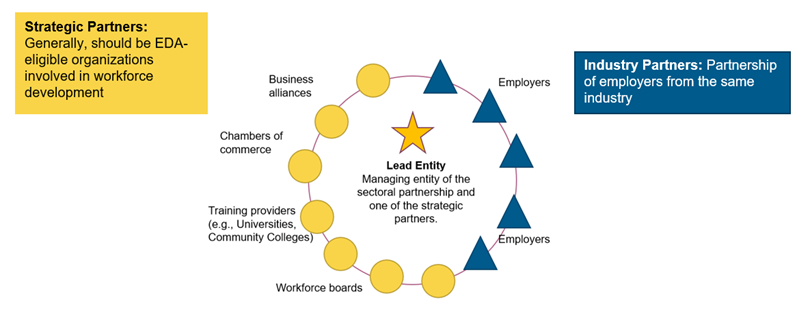
Projects under this AI Addendum support industry-driven sectoral partnerships to support Americans in securing and retaining jobs, consistent with the Trump Administration’s America’s AI Action Plan, Executive Order 14278 Preparing Americans for High-Paying Skilled Trade Jobs of the Future, and America’s Talent Strategy: Building the Workforce for the Golden Age. Sectoral partnerships are effective because they include all necessary partners before workforce solutions are designed; they cut across traditional economic development, workforce, education, and social services system silos; they are targeted to in-demand sectors with high-skilled jobs; and they consider the economic realities of a regional industry in assessing workforce demand and training needs.
5. What is a Lead Entity?
A “Lead Entity” is defined as the award recipient and principal organization leading the sectoral partnership. A Lead Entity must be an eligible applicant.
6. What entities are considered eligible applicants?
Eligible applicants under the AI Addendum include a State, county, city, or other political subdivision of a State; institution of higher education; Indian Tribe; public or private non-profit organization; district organization of an EDA-designated Economic Development District; economic development organization; or public-private partnership for infrastructure, as identified in Section 3(4) of the Public Works and Economic Development Act of 1965, as amended (PWEDA) (42 U.S.C. § 3122(4)(a)) and 13 CFR § 300.3 (Eligible Recipient), as listed in section C.1 of the FY 2023/2024/2025 PWEAA NOFO (p. 8).
Individuals and for-profit entities, including for-profit institutions of higher education, are not eligible applicants under this AI Addendum. Such entities are also not eligible for funding under a subaward. See more information in FAQs #8 and #16.
7. What are the characteristics of an effective Lead Entity?
An effective Lead Entity will have most or all of the following characteristics:
- Convening power in the region and the capacity to coordinate engagement and collaboration across all necessary stakeholders;
- Capacity and a proven track record to coordinate engagement, collaborate across all necessary stakeholders, and drive stakeholders to successful action;
- Project management capacity to ensure programs get implemented, meet employer needs, are leading to long-term positive outcomes for workers and their communities, and meet agreed-upon milestones;
- Strong knowledge of industry and its needs with problem-solving capacity within the sector and ability to grow the sector by developing trust and a base of knowledge with organizations, businesses, and public/private resources;
- Fundraising capabilities or connection to a system with strong fundraising capabilities to support project sustainability; and
- Dedicated full-time employee(s) focused on addressing the industry’s workforce issues to support the industry’s economic growth.
8. Can for-profit employers receive funding under this AI Addendum?
For-profit entities are non-eligible entities, meaning they are not eligible applicants under the AI Addendum, nor may they serve as subrecipients under this AI Addendum. Thus, non-competitive subsidies or payments to for-profit entities for work performed under the project are not permitted.
In addition, project funds cannot be used to subsidize any non-eligible entity’s operating costs or expenses that are unrelated to program activities, including general operating expenses or wage expenses. Project funds may not be passed or transferred to companies being served by the applicant organization. See more information in FAQ #30.
A for-profit entity may participate in the project as a competitively procured contractor, as long as it is procured properly according to federal regulations at 2 C.F.R. §§ 200.317-.327. A contract can be for training or other purposes necessary for a project’s scope of work. However, if the for-profit entity is providing training, the training cannot be exclusively for the entity’s own current or potential employees. All procured contractors for training services must be able to effectively deliver training to all targeted participants, not just those affiliated with the for-profit entity.
For-profit entities are able to provide cost share or match to the project. In fact, the number and strength of employer commitments, relative to the capacity of the region, is considered in merit review.
Please note that other rules of the AI Addendum apply. For example, a provider of matching share, including an entity providing cash or in-kind contributions, may not serve as a contractor under the same award and may not be paid with award funds to provide goods or services to the award recipient.
Finally, a for-profit employer may also benefit indirectly from a project funded under this AI Addendum, such as when its employees are trained by a separate training provider.
9. What is an employer commitment and how do I demonstrate these commitments in my application?
Applicants must submit letters of commitment from employers as indicators of the sector partnership and industry demand for the project. Employer commitments can include participating in and supporting the sectoral partnership; committing to the number of incumbent workers that will use training; committing to hire participants who complete training; providing data on the impact that AI upskilling has had on business outcomes; contribution of match; or engaging in other meaningful project activities.
Letters of commitment must include the information listed in Section 8 of the AI Addendum on p. 54. They should be formatted as business letters on the organization’s letterhead, addressed to the Lead Entity, and signed by the sectoral partnership member’s authorized representative. It is also strongly recommended to put information on employer commitments into a table similar to the Employer Commitment table in Section 2 of the AI Addendum, p. 49, including employer details (name, address, and EIN), a description of the commitment, and that commitment’s relevance to the proposed project strategy.
Please note that employer commitment letters are different from match letters. If the same entity is providing both a commitment and match funding, that organization must submit two separate letters.
10. Does a nonprofit organization need to be legally organized as a 501(c)(3) or a 501(c)(6)?
No. For eligibility purposes, nonprofit organizations are not required to be recognized by the IRS as tax exempt. An eligible nonprofit organization must be an entity organized in accordance with applicable State law that, in accordance with the definition of nonprofit organization at 2 CFR § 200.1, (1) operates primarily for scientific, educational, service, charitable, or similar purposes in the public interest; (2) is not organized primarily for profit; and (3) uses its net proceeds to maintain, improve, or expand the operations of the organization. A nonprofit applicant will be required to provide relevant organizational documentation, including a current certificate of good standing, articles of incorporation, and bylaws.
11. What is cost share or match funding and how does it work on this program?
Cost share or match is the portion of project costs not paid by federal funds or contributions (see 2 CFR 200.1, Definitions). In other words, match consists of the funding or in-kind contributions that the applicant and/or partners commit to the project. Match is part of the project and is subject to federal requirements.
With limited exceptions, cost share is required for projects funded under this AI Addendum. EDA has determined that the maximum allowable investment rate for projects funded under this AI Addendum is 60%.
12. How do applicants demonstrate cost share?
Applicants are required to demonstrate the source and amount of cost share or match consistent with the cost share requirements outlined in section C.2.b., Documentation of Cost Share or Matching, on pp. 9-10 of the FY 2023/2024/2025 PWEAA NOFO, and to provide evidence that the cost share is committed and available for the proposed project. Required commitment letters (or equivalent documentation) must state the type of contribution (cash, loans, bonds, or in-kind); demonstrate that all matching funds are unencumbered, unrestricted, and committed at the time of award; and be signed by an authorized representative. Authorized representatives must have the authority to execute documents and to obligate and expend funds on behalf of their respective organizations.
13. May for-profit entities contribute match or cost share? What if the for-profit entity is interested in bidding for a contract under the project?
Although for-profit entities are not eligible for EDA funding as an awardee (or subawardee) under this AI Addendum, they are able to contribute match. However, a provider of matching share, including an entity providing cash or in-kind contributions, may not serve as a contractor under the same award and may not be paid with award funds to provide goods or services to the award recipient.
14. What is EDA’s distress criteria – “Special Need”? Does my application have to meet the distress criteria?
To be eligible for funding under the AI Addendum, an applicant must demonstrate “Special Need,” as discussed on pages 46-47 of the AI Addendum.
An applicant meets “Special Need for purposes of the AI Addendum if it demonstrates that:
- The focus industry and its associated employers are a significant part of the region or project service area’s economy; and
- AI is currently being used by the relevant industry and the employers associated with the project; and
- AI currently in use by employers in the relevant industry is important to the future competitiveness of the industry and the economy of the region; and
- There is an existing need for training in AI with the employer partners in this project that is necessary to preserve and/or enhance their competitiveness and benefit to the region.
Applicants provide this information in Section 3 and Section 4 of their Project Narrative, as described in the AI Addendum, pp. 49-50.
Note that the AI Addendum supersedes the EDA Investment Rate information provided in Table I in C.2.a of the FY 2023/2024/2025 PWEAA NOFO (p. 9), and the EDA distress criteria that applies to the AI Addendum is Special Need.
15. Can youth-serving (e.g., persons under 18) organizations apply for this funding?
Yes, youth-serving organizations that are eligible entities may apply for funding. Note that immediate job placement or job upskilling is a primary goal of this program, so to be competitive, an applicant will need to demonstrate that its project will create a pipeline of skilled job seekers for high-paying jobs. Traditional K-12 education programs that are not a part of a broader workforce framework leading to immediate placement into jobs (within six (6) months of training completion) may not be as competitive as projects that immediately place workers into jobs.
16. What qualifies an individual as a participant in this program?
A participant in the AI Upskill Program is defined as an individual who is enrolled in a training program that is fully or partly funded by the AI Upskill project. Such individuals benefit from the program through tuition or reduced or no training program costs. They also might receive participant supports that are funded or provided by the AI Upskill project, whether through EDA funding or match.
17. How does EDA define participant support costs? Can EDA funds be used for these services?
Participant supports are services that help mitigate barriers to employment by allowing participants to complete workforce training activities and secure and retain employment. They are allowable costs under this AI Addendum. Examples include costs that are necessary for participation in the program, such as transportation, financial coaching, childcare, and career navigation and coaching. The definition of “participant support costs” can be found at 2 CFR § 200.1.
However, please note that no funds provided under this AI Addendum may be provided to participants as cash or cash-like support. Costs such as work stipends and wage subsidies to participants are not allowable.
18. How should participant supports be provided?
Participant supports generally should be obtained through a competitively procured service provider. As such, they should typically be included as a contract in the contractual category on the project budget. Federal procurement standards at 2 CFR §§ 200.317-327 must be followed for all contracts made under an award.
It is the applicant’s responsibility to determine whether a third party should be characterized as a subrecipient or a contractor pursuant to the factors in 2 CFR § 200.331 (Subrecipient and contractor determinations). All subawards must receive EDA prior approval. If selected for award, and before initial disbursement of any funds by EDA for any costs incurred by a subrecipient, EDA may request documentation demonstrating that the subrecipient is an entity eligible to receive EDA assistance.
19. Are equipment and supplies allowable costs? Can AI Upskill project funding also be used to deploy AI systems and technologies--or may it only be used to train workers?
Supplies and equipment are allowable costs (and match) under this AI Addendum as long as they are necessary to support and expand workforce training programs, as described in the project’s scope of work. Allowable costs may include AI systems and technologies, or other investments necessary to implement skills training, including securing the infrastructure specific to region, industry, and worker roles. These costs must meet cost principles, including reasonableness (outlined in Uniform Administrative Requirements, Cost Principles, and Audit Requirements for Federal Awards at 2 CFR part 200, and must be procured, used, and maintained by the recipient/subrecipient.
Contractor equipment costs are not permitted, and supplies and equipment cannot be purchased by or on behalf of a for-profit employer. Additionally, construction costs are not permitted. Any activity that disturbs the ground or modifies a structure that is not related to the installation and operation of equipment cannot be purchased with award funds or provided as match.
20. Is EDA soliciting project proposals that train in or focus on specific jobs?
No. EDA is not seeking proposals from a specific industry. The sectoral partnerships may train participants for a wide range of jobs in any industry. Applicants will need to identify the focus industry with immediate need for, and opportunities created through, AI adoption and workforce upskilling, along with the skills, tasks, and roles of workers who would benefit from the proposed training. The application should also demonstrate employer demand and benefit for these skills through employer commitment letters.
21. What makes an application competitive?
The AI Addendum details the criteria by which all applications will be reviewed; see pages 55-58, Review and Selection Process. Applicants should align project proposals with AI Addendum requirements and criteria to make an application as strong as possible.
22. What is a Comprehensive Economic Development Strategy (CEDS)? Do the projects under the AI Upskill Accelerator Pilot Program have to be aligned with a CEDS?
CEDS are locally based and regionally driven economic development planning processes, typically prepared by an EDA-designated Economic Development District (EDD) organization, to guide capacity building efforts that best serve economic development in the region.
Each project funded under this AI Addendum must demonstrate, in Section 4 of the Project Narrative on p. 50, consistency with the region’s current CEDS or, if a CEDS does not exist, an equivalent EDA-accepted regional economic development strategy that meets EDA’s CEDS requirements. Applicants may also include letters of support from organizations that prepare CEDS or equivalent plans for areas that will be served by the proposed system and/or project.
Applicants may find a CEDS here: https://www.statsamerica.org/ceds/. Applicants may contact the EDA Representative for their area listed at www.eda.gov/contacts (and in the FY 2023/2024/2025 PWEAA NOFO, Section G) for assistance to locate the applicable CEDS or equivalent plan(s). Applicants from geographies that are not covered by an Economic Development District (EDD) are encouraged to reach out to EDA at [email protected] to help determine a CEDS-equivalent with the subject line: “AI Ready Workforce FY 2026.”
23. What are FIPS codes?
FIPS are standardized numeric codes that provide uniform identification of geographic entities though all government agencies. Applicants are required to include the project’s FIPS codes in Section 4 of their Project Narratives to help describe the project’s location and region, including its project service area.
Applicants may find applicable FIPS code(s) by visiting this page, searching for the project’s State(s) under “County and County Equivalent Entities,” and referencing the corresponding state and county codes.
24. Must the applying organization have an active SAM registration?
Applicants are required to: (i) be registered in SAM before submitting an application; (ii) provide a valid unique entity identifier in the application; (iii) make certain certifications (see also section H.5 of the FY 2023/2024/2025 PWEAA NOFO, p. 33); and (iv) continue to maintain an active SAM registration with current information at all times during which they have an active Federal award or an application or plan under consideration by a Federal awarding agency. See FY 2023/2024/2025 PWEAA NOFO, Section D.3, p. 23. Lead Entities should begin registration in SAM by the Application deadline.
SAM registration must be complete before EDA may make an award under this AI Addendum. EDA may not make an award to an applicant until the applicant has complied with all applicable unique entity identifier and SAM requirements and, if an applicant has not fully complied with the requirements by the time the EDA is ready to make an award, EDA may determine that the applicant is not qualified to receive an award.
25. Must I include a budget narrative and staffing plan with my application?
Yes. The budget narrative and staffing plan lay out the intended uses of program funding and how the program will be executed. Strong applicants will typically include one or more full-time employees dedicated to the project and have personnel or budget narrative line items for grants management (e.g., project management, fiscal oversight, compliance, legal advice, data reporting and evaluation, etc.).
The staffing plan must include position titles, maximum annual salaries, percentage of time dedicated to the project, and the total amount of annual salaries and fringe benefits that would be charged to the project.
To help make this requirement easier, EDA created a budget narrative and staffing plan template that applicants are strongly encouraged to use.
26. Can an organization submit multiple applications for the AI Upskill Accelerator Pilot Program?
Yes. An applicant can submit multiple applications as long as the applications are for separate and distinct projects, and each application is supported by its own match commitment.
27. How are applications submitted?
An applicant must obtain, complete, and submit an application electronically through the Economic Development Grants Experience (EDGE) at sfgrants.eda.gov. EDA will not accept paper, facsimile, or email transmissions of applications except in to accommodate applicants’ accessibility requirements (see FAQ #28). In order to obtain and submit an application through EDGE, an applicant must register for an EDGE account at sfgrants.eda.gov. As part of the registration process, an applicant must register one Authorized Representative for its organization. The Authorized Representative will be the only official with the authority to submit applications.
28. What alternatives are there for the submission of applications?
To accommodate applicants’ accessibility requirements, a paper version of the application may be obtained by contacting EDA’s Office of Innovation and Entrepreneurship (OIE) via email at [email protected]. EDA also will provide the requestor with the application in an accessible format that may include Rich Text Format (RTF) or text format (txt), a thumb drive, an MP3 file, braille, large print, audiotape, compact disc, or other accessible format.
29. Will EDA reach out with questions on an application and who would this inquiry go to? How will applicants receive notification about selection results?
Throughout the review and selection process, EDA reserves the right to seek clarification in writing from applicants whose application packages are being reviewed. This inquiry would go to the authorized representative listed in EDGE, so applicants should ensure that this contact information is accurate, up to date, and monitored closely during the review and selection period. Applicants that do not provide additional information and supporting documentation in a timely fashion or that are deemed not to be in compliance with applicable rules and regulations, will receive notification that their application was not successful.
If an applicant successfully and timely completes all due diligence requirements and the application is selected for funding, EDA will notify the successful applicant by writing or emailing the authorized representative listed in EDGE. This notice is not an authorization to begin work, however; work should not be undertaken until the Notice of Award is signed by EDA and the applicant’s authorized representative.
30. What costs are not allowable in in the AI Upskill Accelerator Pilot Program?
The following use of project funds, whether provided by EDA or match sources, are not allowable costs under this AI Addendum:
- For-profit entities. Project funds cannot be used to reimburse for-profit entities for training that is exclusively for the entity’s employees. Project funds cannot be used to subsidize an employer’s wage expenses or a non-eligible entity’s operating costs. Project funds may not be passed or transferred to companies being served by the applicant organization, nor may they be used to subsidize such companies’ expenses that are unrelated to program activities, including general operating expenses. In addition, project funds cannot be used for contractor equipment purchases. See FAQ #8 for more information.
- Individuals. Project funds cannot be provided to individuals directly as cash or cash-like payments.
- Management fees. Project funds may not be used to pay for management fees in excess of costs or profits, unless statutorily authorized.
- Collective bargaining. Project funds may not be used, directly or indirectly as an offset for other funds, to support or oppose collective bargaining.
- Financial equity or hybrid investments in businesses. Project funds cannot be used to make financial equity or hybrid investments in businesses. EDA funding cannot be provided directly to private entities or individuals for any activities or costs.
- Advertising & Marketing. The costs of promotional items and memorabilia, including models, gifts, and souvenirs as well as the costs of advertising and public relations designed to promote the applicant are not allowable, in accordance with 2 C.F.R. § 200.421(b) and (d),. However, certain costs related specifically to recruiting participants and conducting program outreach (e.g., social media ads, press releases, flyers, etc.) may be allowable.
- Cloud Service Credits. Credits to be distributed to companies (i.e., startups and individuals) being served by the applicant organization are not allowable costs and thus are not an allowable source of matching share.
- Construction Costs. Any activity that disturbs the ground or modifies a structure that is not related to the installation and operation of equipment, and not pre-approved by EDA, cannot be purchased with award funds or provided as match.
- Funds to Contractors that Provide Cash or In-Kind Match. Contractors that develop draft specifications, requirements, statements of work, invitations for bids, or requests for proposals are prohibited from competing for the final procurement, unless exempted by 2 C.F.R. § 200.317, Procurements by States and Indian Tribes. See Notice of Government-Wide Procurement Restriction, section H.3 of the FY 2023/2024/2025 PWEAA NOFO.
- Pre-award costs. In general, EDA does not reimburse pre-award project costs. For pre-award procurement costs to be eligible for reimbursement, the applicant must competitively procure services pursuant to the Federal government’s procurement procedures. All pre-award costs are incurred at the applicant’s own risk and will be considered for reimbursement, in EDA’s sole discretion, only if an applicant receives an award and such costs are approved by EDA in writing. Under no circumstances will EDA or DOC be held responsible for application preparation expenditures, which are distinguished from pre-award project costs.
- Other. Project funds cannot cover any costs that are not allowable, allocable to the award, necessary, reasonable, and otherwise permitted to complete the scope of work under a funded award, as outlined in Uniform Administrative Requirements, Cost Principles, and Audit Requirements for Federal Awards at 2 C.F.R. part 200.
31. What does an applicant do if it has questions during the application period?
EDA is dedicated to providing quality customer service and supporting applicants through the application process. We will provide multiple public webinars for technical assistance, which will be posted on eda.gov/ai-upskill. Applicants are also welcome to email [email protected] for assistance. Include in the subject line: “AI Ready Workforce FY 2026” for ease of response.
32. How should applicants set worker benefit targets for projects when employer participation and employee counts are not yet finalized?
Applicants should propose worker benefit targets that are ambitious yet reasonable based on the information available at the time of application.
Applicants are also expected to use reliable labor market information to help inform realistic and evidence‑based worker benefit targets. Use of reliable labor market data sources can strengthen the rationale for proposed numbers and demonstrate that targets reflect actual labor market needs.
33. Are there any eligibility requirements, preferences, or evaluation considerations related to the size of participating employers, such as whether they are small, medium-sized, or large businesses?
No. The size of employers in the project does not affect eligibility or give any special advantage in the application process. Applicants should focus on demonstrating meaningful employer engagement and the potential workforce and economic impacts of the proposed project.
34. Are measurable wage gains for incumbent workers a required outcome under the incumbent worker training component, or may applicants propose other outcomes, such as credential attainment or skill development?
Wage gains are not a required performance outcome for incumbent worker training. However, wage data will be collected and evaluated as part of program monitoring and evaluation. Applicants are encouraged to identify the outcomes they expect to achieve, whether wage gains, credential attainment, skill development, or other benefits to help demonstrate the value of the proposed training activities.
35. Will the lead entity be responsible for collecting and submitting participant questionnaire data, or will this information be gathered directly by EDA?
The lead entity is responsible for ensuring that required data is collected and submitted. EDA will provide a data collection system for this purpose, and additional guidance will be provided. Additionally, among other things, the lead entity will be responsible for coordinating and ensuring partner participation in the reporting process.
36. What project-level evaluations are acceptable under this program?
EDA does not require a specific evaluation methodology. Applicants should propose an evaluation approach that is appropriate and feasible for their project. Evaluation activities may focus on implementation, process, outcomes, or impact, as appropriate. EDA may facilitate connections with researchers or evaluators interested in studying this work.
37. Are applicants required to include a third-party evaluator as part of the project team, or will EDA provide or coordinate evaluation support for selected award recipients?
Applicants are not required to include a third-party evaluator as part of the project team. However, during application review, EDA will assess the adequacy of the applicant’s proposed approach for evaluating the project’s impact on workforce and business outcomes. Applicants must include a plan for evaluating the effects of project activities on employee and business outcomes, including outcomes that may be assessed after the period of performance.
38. What if participating employers are unwilling to share personally identifiable information (PII) needed for program reporting or evaluation?
Applicants should be aware that if their project is selected, they will be required to collect and report certain data. They will be responsible for working with participating employers, organizations, and participants to address data-sharing concerns and establish appropriate processes for collecting the information required for program reporting and evaluation.
39. Will training curriculum used or developed under this program be required to enter the public domain or otherwise be made publicly available?
Yes. Training curriculum and other materials developed with EDA funding must be made publicly available. Pre-existing curriculum developed without EDA funding is not subject to this requirement. Note, however, that while it is in the public domain, a grantee also owns any work produced or purchased under an award and has the right to copyright it under 2 C.F.R. § 200.315.
40. Will tables, charts, and other visuals included in the project narrative count toward the 12-page limit?
Yes. Tables, charts, and other visuals included in the project narrative count toward the 12-page limit. Applicants are encouraged to review the required content and determine the most effective way to present that information within the page limit.
41. In the project narrative, is it acceptable to orient tables in landscape format rather than portrait? Additionally, can font size within tables be reduced to accommodate the requested information?
The AI Addendum does not specify any requirements regarding page orientation. Please note that there is a strict 12-page narrative limit (see AI Addendum, p. 47), and any material exceeding the 12th page will not be reviewed or considered.
Font size in tables may be smaller than 12-point. However, it is important to ensure that the font remains clear and legible for reviewers, as they will not make adjustments to enhance readability of submitted materials.
42. Are employer commitment letters acceptable if they don’t include every item listed on page 54 of the AI Addendum?
EDA recognizes that employer engagement and commitments vary across sectoral partnerships. However, strength of employer commitments is evaluated as a part of the competition, and applicants should ensure employer commitment letters detail as much of the information on page 54 (PDF) as possible.
43. How should applicants demonstrate Special Need if the System Development phase will be used to identify the target industry and determine future training priorities?
An applicant must demonstrate all four points of Special Need to be eligible for an award under the AI Addendum (see pp. 46-47 of the AI Addendum). Applicants should address each Special Need question based on the information currently available. Describe what is known, identify any assumptions or hypotheses where information is still being developed, and explain how the System Development phase will help refine those findings and inform future training priorities.
Applicants are also expected to use reliable labor market information to help inform realistic and evidence‑based responses.
44. Are there specific geographies that should be the primary focus?
No. The competition is open to all eligible applicants from any region. Eligible applicants for AI Upskill grants are those identified in 42 U.S.C. § 3122(6)(A) and 13 C.F..R § 300.3 (Eligible Recipient), and as listed in section C.1 of the FY 23/24/25 PWEAA NOFO, p. 8.
45. How should applicants define the project region, and may a project serve multiple regions covered by more than one CEDS?
Applicants are required to describe the project’s location and region, including its project service area, and address how the proposed project will be consistent with the region or regions’ CEDS. See AI Addendum, p. 50. The applicant should self-define project areas geographically. based on the location of the proposed activities and the areas being served. A region may consist of a county, city, multi-county area, multi-state area, or another appropriate geographic area. Geographic areas comprising a region need not be contiguous or defined by political boundaries, but should constitute a cohesive area capable of undertaking self-sustained economic development. 13 C.F.R. § 300.3 (Region). Projects may serve multiple regions that are covered by more than one CEDS; however, applicants should clearly explain how the relevant CEDS strategy aligns with the other CEDS and the proposed project as a whole. See FAQ #22 and 13 C.F.R. § 303.7, Requirements for Comprehensive Economic Development Strategies, for additional information on CEDS.
46. Can a project serve multiple regions or two or more localities?
Yes. Applicants are welcome to propose projects that serve multiple regions; however, it is important that the overall proposal demonstrates strong alignment with the applicable CEDS plan or plans or equivalent for the chosen region(s), as outlined in (FAQs #22 and #45).
We encourage applicants to review the project core components and build a proposal that closely aligns with those core components. If an applicant intends to serve multiple regions or states, it is expected the overall proposal will demonstrate alignment with the core components of the funding opportunity.
47. May costs associated with the required five-year post-award progress reporting be included in the project budget or counted as matching contributions, if they occur after the period of performance?
No. Federal funds may be used only for authorized purposes conducted during the period of performance. Costs incurred after the award period of performance, including on activities related to the five-year post-award progress reporting requirement, may not be charged to the award. In addition, match must be available and committed at the time of award. Match must be or counted toward the project's matching requirement during the award period of performance.
48. May applicants propose multiple levels of AI training, including foundational AI literacy and introductory skills, or should projects focus exclusively on advanced AI skills?
Applicants may propose the AI training approach that best meets the needs of their workforce and industry partners. Proposals should clearly demonstrate how the proposed training strategy—whether focused on foundational, intermediate, advanced, or multiple levels of AI skills—addresses regional workforce needs and project objectives.
49. Is there a recommended cost-per-participant target for training and support services, and how should applicants calculate that figure?
EDA does not require a specific cost per participant, although $10,000 per participant is commonly used as an example. The right cost will depend on the training type, length, and depth. Applicants should request costs that are reasonable and well supported by their project plan. All costs must be reasonable, necessary, allowable, and consistently treated, in compliance with the cost principles at 2 C.F.R. part 200, subpart E.
50. Should applicants include funding for grantee convenings in the project travel budget?
No. At this time, EDA does not anticipate requiring grantee convenings that applicants should include in their travel budgets.
51. What is an “Economic Development Organization”?
For the purposes of the AI Addendum, an economic development organization is defined as an established organization with a primary purpose to support the economic development of a community or region. It is co-extensive with district organizations and/or Economic Development Districts and non-profits. This definition is intended to provide clarity without expanding eligibility to any for-profit organizations, even if they are described as “economic development organizations.”
To evaluate an organization’s eligibility as an economic development organization or similar entity, EDA will look at the organization’s Articles of Incorporation, Charter, Resolutions, Bylaws, and other documents that may be relevant to establish the primary purpose of the organization.
52. May partners provide matching funds without committing to hiring or training activities, and does this include in-kind contributions?
Yes. Partners may provide cash or in-kind matching contributions without committing to hiring or training activities. Match commitment is not the same as employer or stakeholder commitments. For more about cost share or match, see the AI Addendum, p. 46. For more on employer commitment, see AI Addendum, p. 54.
53. What cost share or match funding source is allowable on this program?
Applicants may use a variety of non‑federal sources to meet the required cost share for a project funded under the AI Addendum. Cost share or matching funds may come from any applicant, co‑applicant, or other contributing partner, including employer partners, as long as the funds meet federal requirements.
However, note that a provider of matching share, including an entity providing cash or in-kind contributions, may not serve as a contractor under the same award and may not be paid with award funds to provide goods or services to the award recipient.
54. Is program income considered an allowable source of cost share?
Cost share requirements outlined in section C.2.b, Documentation of Cost Share or Matching, on pp. 9-10 of the FY 23/24/25 PWEAA NOFO state that match must be unencumbered, unrestricted, and committed at the time of the award. As program income would be generated after the award start date, it cannot be pledged as a match source. That said, if a project generated program income post-award, EDA would consider allowing a match swap post-award. This is no guarantee. Regardless, at the time of award, match must be secured and committed, and applicants must assume that a match swap will not be possible.
55. Can federal funding be used as match on the award if the federal funding statute does not state whether matching is permissible or a disallowed activity?
No. Funds from other federal financial assistance awards may be considered matching share funds only if explicitly authorized by statute, which may be determined by EDA’s reasonable interpretation of the statute. See FY 23/24/25 PWEAA NOFO, pp. 9-10. An applicant that wishes to use federal funds as match should contact EDA as soon as possible.
56. Can trainee wages count as match on an award?
Yes, stipends or wages may be allowable costs when counted as match, even though payments to program participants using EDA funds are not allowable. See FAQ #30 and AI Addendum, p. 58, Funding Restrictions.
57. If a for-profit training provider is identified as a strategic partner in the proposed project, may that entity also compete for and receive a contract through a subsequent competitive procurement process?
Yes. A for-profit training provider may serve as a strategic partner and compete for a procurement contract, provided it does not contribute cost share or matching funds to the project (see FAQ #13 regarding for-profit donors of cost share and match funding), and the recipient follows federal procurement requirements. All contracts must be procured using a full and open competitive procurement process, consistent with 2 C.F.R. §§ 200.317-327.
58. Is a subawardee eligible to contribute match to the project?
Yes, a subawardee under an AI Upskill project may contribute match. Contractors, however, cannot donate match and receive award funds under the same award.
59. How can applicants that are public or private non-profit organizations demonstrate cooperation with officials of a political subdivision of a State?
A letter of support from a political subdivision or office of a State is sufficient to meet this requirement. This can be uploaded as an attachment with the application.
60. What does "employer-validated" look like when training programs already exist? What documentation would be required for employer validation of training?
In this competition, EDA does not prescribe a single method or document for employer validation. Instead, the intent is for each sectoral partnership to demonstrate, through evidence that is appropriate for their industry and partners, that the training proposed is aligned with employer‑identified AI skill needs and has been confirmed as relevant by employers in the partnership.
For example, applicants may demonstrate employer validation through:
- Employer commitment letters describing how the training aligns with their skill needs, how they intend to engage with or hire from the program, or how the curriculum reflects real‑world AI use cases in their operations.
- Narrative descriptions in the proposal explaining how employers participated in reviewing, informing, or endorsing the training (e.g., through sector partnership meetings, curriculum review sessions, or ongoing industry advisory input).
- Outcome evidence, if available, showing that the training already works—such as prior cohorts completing the program, participants being hired or advanced by employer partners, or measurable improvements in skills that employers have identified as in‑demand.
- Employer participation in curriculum development or refinement, including identifying AI tasks, tools, or competencies necessary for specific occupations.
- Hiring or advancement history, demonstrating that employers have hired or promoted individuals who completed the training.
61. Is an impact evaluation an allowable cost (either through federal funding or match) during the period of performance?
Yes. Applicants may use federal award funds or match to support data reporting and evaluation activities, including impact evaluation, as long as the activities occur within the period of performance. Applicants should consider how to best maximize the federal investment when budgeting for evaluation. If evaluation costs substantially reduce the resources available for direct training or other core project activities, it is acceptable—and often advisable—to cover some or all evaluation expenses with match.
62. Will the AI Upskill Accelerator provide funds to recipients through a reimbursement or advance payment method?
Generally, recipients will be in advance payment status, but recipients may request funding through a reimbursement payment method if needed. The EDA team will work with recipients through award processing to align on EDA policies and the needs of the grantee.
63. Is there a target number of training participants and workers that EDA expects in an application?
EDA has not set a target number of participants for the AI Upskill program. EDA expects applicants to identify and commit to reasonable participant outcomes and targets based on the AI need identified and the sectoral partnership’s capabilities.
64. Do restrictions on subsidies or payments to employers apply to non-profit employers who would otherwise be eligible to receive award funding under the AI Addendum? For instance, if a non-profit employer runs a training program to train or upskill its employees, would that be allowable?
Non-profit employers are not prohibited from using award funds to run a training program. However, using program funds for a nonprofit employer to train its own employees may not be consistent with the AI Addendum. Entities providing training services must be able to effectively deliver training to all targeted participants, not just those affiliated with a certain entity.
65. The AI Addendum states that there are limited exceptions to the 60% investment rate. What are the exceptions?
Under 42 U.S.C. § 3144(c), EDA can potentially extend up to 100% of project costs to the following:
- An Indian Tribe;
- A State, or a political subdivision of a State, that has exhausted its effective taxing and borrowing capacity or can otherwise document that no local matching funds are reasonably obtainable;
- A nonprofit organization that has exhausted the effective borrowing capacity of the nonprofit organization; and
- A political subdivision of a State that has a population of fewer than 10,000 residents and meets 1 or more of the eligibility criteria described at 42 U.S.C. § 3161.
Please see footnote 12 in the AI Addendum.
66. Has EDA established an anticipated or required period of performance for this grant, including the expected start and end dates?
EDA anticipates awards to be made in late 2026, but this is not a firm timeframe. Once awards are made, EDA will grant a 24- or 36-month period of performance based on the timeline indicated in the award narrative and potentially other factors.
Additionally, as stated in the FY 23/24/25 PWEAA NOFO, Section F.1. – Federal Notice Award, if an applicant is selected for funding, EDA will notify the successful applicant in writing about its selection. This notification does not start an award or authorize any costs. Rather, after initial notification, the EDA Grants Officer will issue the Notice of Award, which is the authorizing financial assistance award document. The fully executed Notice of Award will include the award start and end dates.
67. What occupations can sectoral partnerships propose for training under this program?
Sectoral partnerships may propose any occupation they determine is necessary to address the AI‑related need(s) identified in the application. Proposed occupations should be directly connected to the AI impact or challenge described, or clearly support the Special Need eligibility criteria the applicant aims to meet.
68. Can a single eligible entity serve as the Lead Entity on one application while also participating as a partner or sub-awardee on a separate application submitted by a different Lead Entity?
An entity can serve in multiple roles on the same project. However, the scope of work, costs, and match cannot duplicate or overlap with any other award costs.
69. What if a proposal aligns with another federal investment?
Applicants should indicate if other federal funds have been secured for, or have been requested to support, any portion of the project for which an EDA investment is proposed. Applicants should describe how the EDA investment will complement, leverage, or otherwise align with other public and private investments to implement the project. Where other federal funding may be involved in the project, the applicant should provide the federal program name and contact information with their application to facilitate interagency coordination and avoid duplication of resources. Note that consistent with 2 CFR § 200.306, not all sources of federal funding may be allowed as match. See FAQ #55.